Maryland Rent Court: A Step-by-Step Guide for Landlords and Property Managers (2026)
If you search for help with Maryland rent court, almost everything you find is written for tenants. The court system's pages, the legal aid guides, the Attorney General's office. All useful, none of it tells a landlord or property manager what to actually do, or when.
This guide covers the failure-to-pay-rent process from the landlord side: every step from a missed payment to eviction day, with the deadlines that change depending on which county the property sits in. We manage properties in Maryland and run this process every month, so the day counts below are the ones we actually work from.
One caveat before we start. This is operational guidance, not legal advice. Deadlines and procedures change, and counties interpret rules differently. Confirm specifics with the District Court or your attorney before you rely on them.
What rent court is in Maryland
"Rent court" is the informal name for a failure-to-pay-rent (FTP) case heard in the Maryland District Court under Real Property § 8-401. It is a summary proceeding, which means it moves fast compared to other civil cases, and it is the only lawful way to remove a tenant for nonpayment. Changing the locks yourself is illegal in Maryland, full stop.
Two things make these cases harder than they look:
- The process is deadline-driven. Each phase has a day count, and the counts differ by county. File the complaint too early and it gets dismissed. Wait too long and you've donated a month of rent.
- The burden of proof sits with you. You need a current ledger, a properly completed Notice of Intent, and legally defensible proof that the notice was mailed. Miss any one of those and you can lose a case the tenant didn't even show up for.
The full timeline at a glance
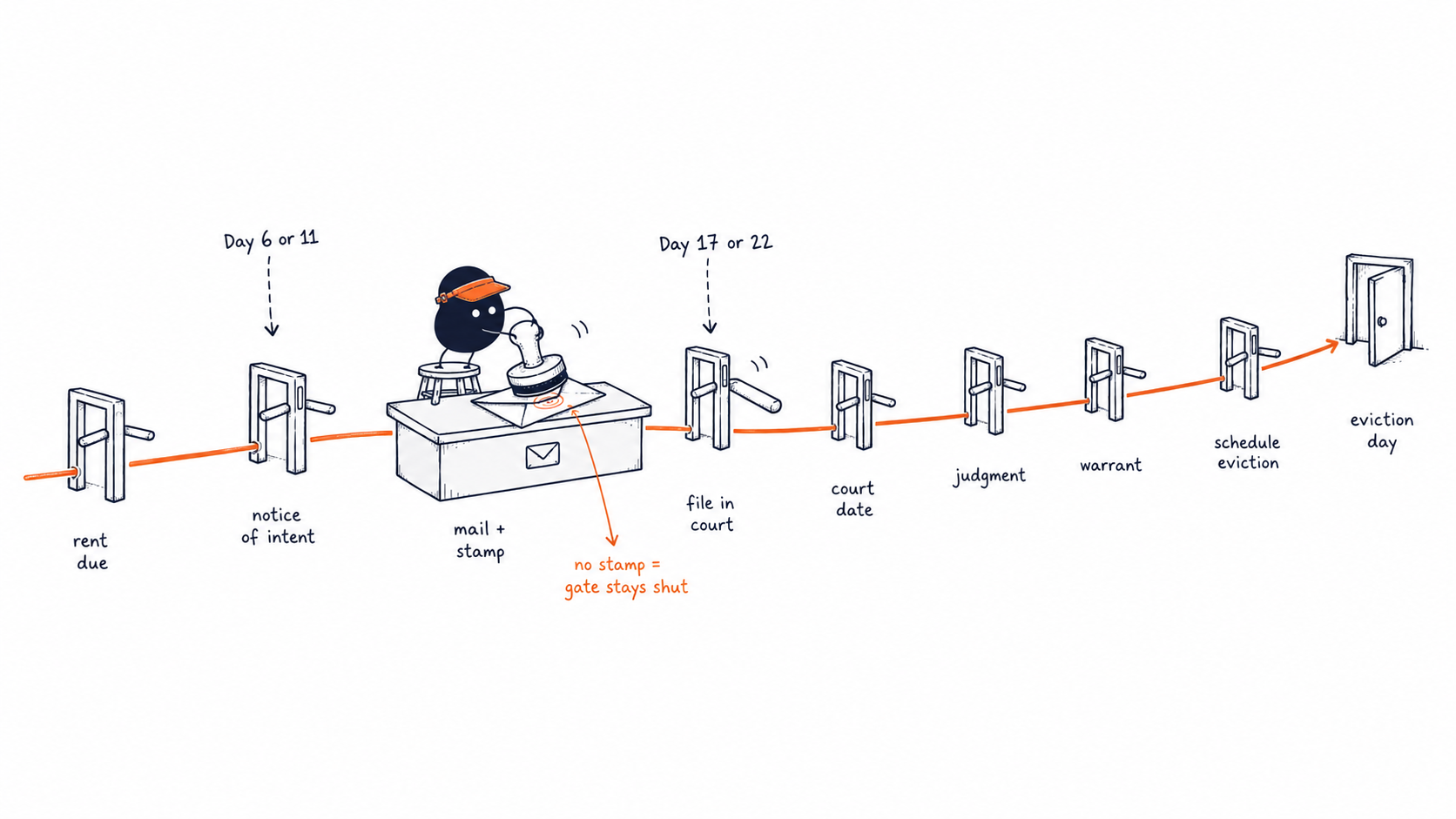
The nine steps of a Maryland failure-to-pay-rent case, in order. You cannot skip a gate: the Notice of Intent goes out on day 6 (day 11 in Baltimore City), the complaint is filed on day 17 (day 22 in Baltimore City), and nothing past the mailing step holds up in court without a stamped Certificate of Mailing.
Here is the same flow with the county-specific triggers we work from:
Step | Baltimore City | Baltimore County | Harford County | Anne Arundel County |
|---|---|---|---|---|
Send Notice of Intent | Day 11 | Day 6 | Day 6 | Day 6 |
File FTP complaint | Day 22 | Day 17 | Day 17 | Day 17 |
Schedule eviction via | Sheriff's website | Call the constable | Call the sheriff | Confirm with county |
Mover/hauler required | No | Yes | Yes | Confirm with county |
Pre-eviction notice | 14 days prior, mailed with certificate | 6 to 8 days prior, mail + posting + electronic | 4 days prior, mailed with certificate | Confirm with county |
Anne Arundel's post-judgment procedures are the least standardized of the four; call the county before you act on a warrant there.
Step 1: send the Notice of Intent to File
The Notice of Intent (NOI) is a state-mandated warning to the tenant that you intend to file for failure to pay rent. It goes out on the standard Maryland form with the tenant's name, the property, the landlord, and the exact balance owed.
When it goes out depends on the county. In Baltimore County, Harford County, and Anne Arundel County, the NOI is sent on day 6 after rent was due. Baltimore City gives the tenant longer: day 11.
Get the balance right. The number on the NOI should come from the tenant's actual ledger on the day the notice is generated, not from memory or a spreadsheet that was accurate two weeks ago. If you manage in AppFolio, pull the ledger the same day you send the notice.
Proof of mailing is the whole game
Sending the NOI is not enough. In court, you have to prove it was mailed, and the document that proves it is a USPS Certificate of Mailing (Form 3665). It is a round-stamped receipt from the post office showing the piece entered the mail stream on a specific date.
No certificate, no defensible proof. Judges hear "I definitely mailed it" every day, and a tenant who claims they never got the notice can sink your case if your only evidence is your word. Getting certificates at volume is its own grind, since Form 3665 firm books are filled out line by line per tenant and stamped at the counter. We'll cover the certificate process in its own guide, because it deserves one.
Step 2: file the failure-to-pay-rent complaint
If the balance is still unpaid on filing day, the FTP complaint gets filed with the District Court for the county where the property sits. Filing day follows the same county split as the NOI: day 17 in Baltimore, Harford, and Anne Arundel counties, day 22 in Baltimore City.
Two operational notes:
- Check the ledger before you file. Tenants pay late constantly. If the balance cleared on day 15, the case is over and filing anyway wastes a fee and your morning.
- Filing fees vary by county. Budget for them per case and track them, because in many situations they can be added to what the tenant owes. Confirm current amounts with the District Court clerk.
Keep an internal file number for every case from the moment you file. It carries through the warrant and eviction paperwork later, and it is the only sane way to track twenty cases across three counties at once.
Step 3: the court date
After filing, the District Court assigns a hearing date and notifies both parties. Put it on the calendar the moment it arrives. A landlord who misses their own hearing gets the case dismissed and starts the clock over from zero.
Then prepare, and prepare late on purpose. The single most useful habit in rent court prep: refresh the tenant's ledger one to two days before the hearing. The balance you state in court must be current. A tenant who made a partial payment last week can discredit your whole packet if your numbers don't reflect it.
Your hearing packet should include:
- The current ledger
- The Notice of Intent
- The Certificate of Mailing for the NOI
- The lease
- Your court notice with the case number
Step 4: judgment, and the tenant's right of redemption
If the court finds rent is owed, it enters a judgment for possession in your favor. That does not mean the tenant is out next week.
Maryland tenants generally have a right of redemption: pay the full judgment amount, plus allowable costs, before the eviction is executed and they stay. Landlords call it "pay and stay." It exists in most FTP cases, although tenants who repeatedly force judgments can lose the right after a number of judgments in a 12-month period. The exact rules have wrinkles, so treat redemption as the default assumption and ask your attorney about the exceptions.
What this means operationally: a judgment is not an outcome, it is a lever. Many cases end here because the tenant redeems. Your job is to keep the case moving so that if they don't, you aren't starting the next phase from a standstill.
Step 5: the warrant of restitution
If the tenant neither pays nor leaves, the next filing is the warrant of restitution, which is the court's order authorizing the sheriff or constable to put you back in possession. Each county has a waiting period after judgment before the warrant can be filed, and warrants expire if you sit on them, so file when eligible and track the dates.
This is the phase where cases quietly die. The hearing is over, the adrenaline is gone, and the warrant filing slips while the tenant sits in the unit rent-free. If you take one process improvement from this guide: put the warrant eligibility date on a countdown the day judgment is entered.
Step 6: scheduling and executing the eviction
Once the warrant is ordered, scheduling works differently in every county, and this is where the table above earns its keep:
- Baltimore City: schedule through the sheriff's website. No mover is required. A pre-eviction notice goes to the tenant 14 days before the date, mailed with a certificate of mailing.
- Baltimore County: call the constable to schedule. You must provide a mover or hauler. Notice goes out 6 to 8 days prior, and it takes three forms: mail, posting on the property, and electronic notice.
- Harford County: call the sheriff. Mover required. Notice is mailed with a certificate 4 days prior.
- Anne Arundel County: procedures are less uniform; confirm scheduling, mover, and notice requirements with the county when the warrant is ordered.
On eviction day, the sheriff or constable supervises, possession returns to you, and the locks get changed. In Baltimore County and Harford County, plan for the tenant to have a 24-hour window to return and collect belongings, which means your crew may be coming back tomorrow.
Where landlords actually lose rent court cases
After enough cycles through this process, the failure points are predictable:
- The deadline math is done by hand. Someone is counting days from a due date across a spreadsheet of tenants in three counties with two different day counts. Eventually a day-6 county gets the day-11 treatment, and the case slides a month.
- There's no certificate of mailing. The NOI went out, nobody can prove it, and the judge has nothing to rule on. This is the most expensive version of "we'll do the paperwork later."
- The ledger is stale at the hearing. A partial payment from last Tuesday isn't reflected, the tenant points it out, and your credibility goes with it.
- The warrant never gets filed. Judgment entered, case forgotten, tenant still in the unit 60 days later.
Every one of these is a process failure, not a legal one. That is the reason we built the rent court module in Realty Pilot Suite. It watches AppFolio delinquencies nightly, opens a case the day a county's NOI threshold is crossed, generates the NOI from the live ledger on the state form, handles the Certificate of Mailing, and runs the county countdowns so the FTP filing and warrant dates never slip. You approve the decisions; the system does the counting.
Maryland rent court FAQ
How long does the Maryland eviction process take for nonpayment? From missed rent to eviction day, expect roughly two to three months when everything runs on schedule: NOI at day 6 or 11, filing at day 17 or 22, then the hearing, the post-judgment waiting period, the warrant, and county scheduling queues. Contested cases and busy sheriff calendars stretch it further.
Do I need a lawyer for rent court in Maryland? Many landlords and property managers handle routine FTP cases themselves, since it is a summary proceeding built for volume. Entity ownership can complicate who may appear, and anything contested is worth counsel. Ask the District Court clerk what your county requires.
What is a warrant of restitution? The court order, issued after a judgment for possession, that authorizes the sheriff or constable to restore possession of the unit to you. It is filed after a county-specific waiting period and is the legal trigger for scheduling the eviction.
Can the tenant stop the eviction by paying? Usually, yes. Under the right of redemption the tenant can generally pay the full judgment amount plus allowable costs any time before the eviction is executed. Repeated judgments within 12 months can cost a tenant that right, so track judgment history per tenant.
Does the process differ by county? Yes, materially. The NOI day, the filing day, who schedules the eviction, whether you need a mover, and the pre-eviction notice rules all vary. The table near the top of this guide shows the differences for Baltimore City, Baltimore County, Harford County, and Anne Arundel County.
Run it like a process, not a crisis
Rent court rewards landlords who treat it as a repeatable workflow with dates, documents, and proof, and it punishes everyone else one missed deadline at a time. Build the county day counts into your calendar, never mail an NOI without a Certificate of Mailing, and refresh the ledger before every hearing.
Or let software do the counting. Book a demo and we'll show you how Realty Pilot Suite runs this entire timeline against your AppFolio portfolio automatically.